Tuesday, December 07, 2021

Basic 3/4 ride and hi-hat combinations

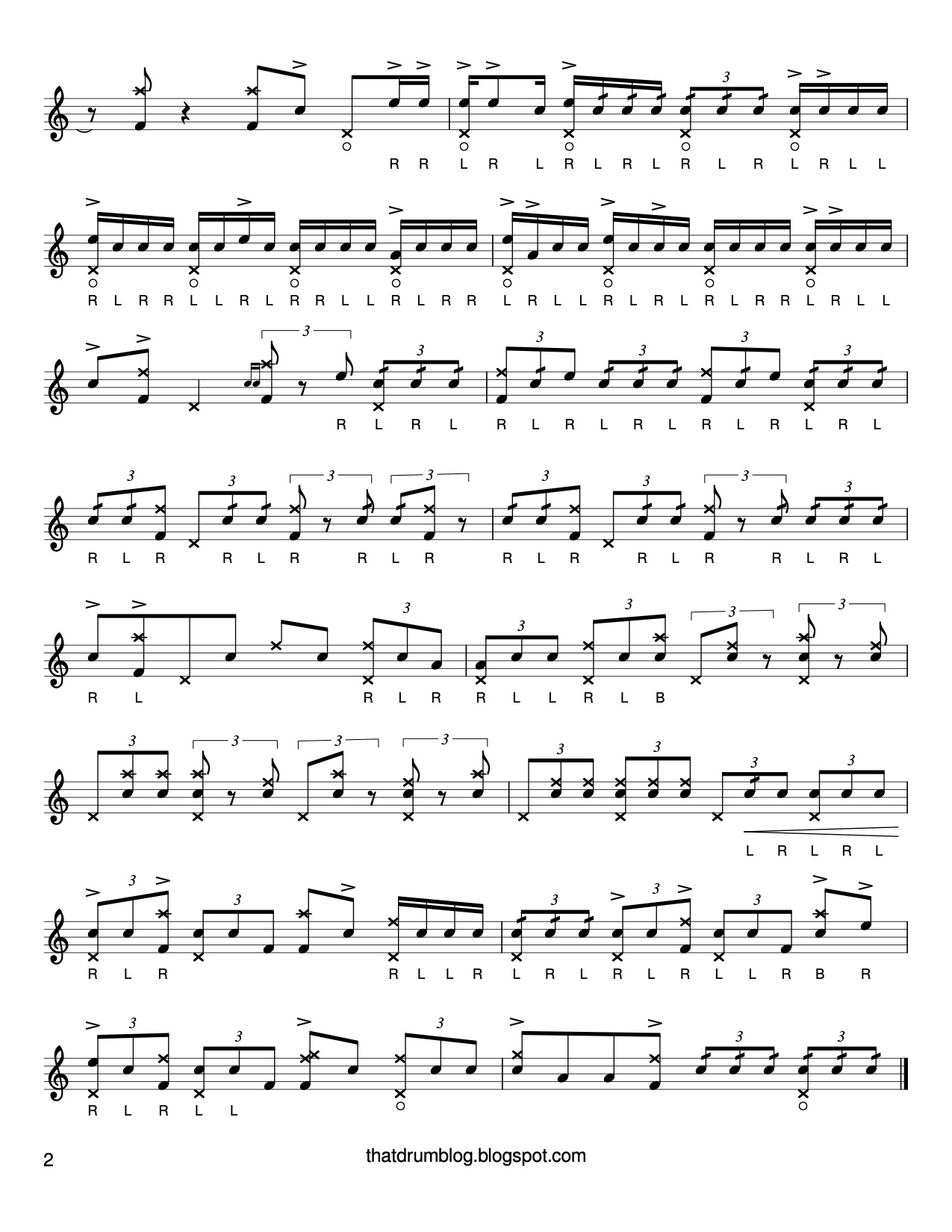
I try not to post too much stuff here on the blog that is already widely available in a million other places, but I recently put this sheet together for a student and figured there was no harm in sharing it with all of you as well.  If nothing else maybe it will serve as a reminder to occasionally revisit the "basics".

I generally try to play through anything I give my students to make sure that A) the sheet is right, and B) I'm not asking them to do anything I haven't shed myself.  And funnily enough, while not difficult, this sheet showed me that there are certain ride and hi-hat combinations that just never made their way into my day-to-day playing.  It's not that I couldn't play them, but they just didn't feel as natural, especially when getting the left hand involved.  So it's been fun putting on Max Roach's Jazz in 3/4 Time and take these for a spin.


Tuesday, November 30, 2021

The Brush Book Joe Morello Never Wrote

We can complain about algorithms all we want, but they often find interesting things for us.  Because of the videos in the last post about Mel Brown playing through Brush Artistry YouTube recommended to me a series of videos by Jon Hazilla, who I'm not familiar with, but apparently teaches at Berklee.

Jon studied with Joe Morello, and later developed his own approach to Master Studies using brushes to develop facility with lateral strokes.

I've been revisiting Master Studies lately myself (with sticks, that is), so I think I'll be giving this a try soon.

Thursday, November 18, 2021

Mel Brown demonstrating Philly Joe's "Brush Artistry"

In a recent excursion down the YouTube rabbit hole I came across a YouTube playlist of Portland drumming legend Mel Brown demonstrating each of the patterns in Philly Joe's venerable book Brush Artistry.  These are short, sweet, and to the point if you have any doubts about how the material in the book should be executed.

As the book is many years out of print, I can't see how there'd be much harm in sharing the fact that a scanned copy of it can be found here.  We certainly wouldn't want it to be lost to time.


Coincidentally, Mel was recently interviewed by Christian McBride on NPR's Jazz Night in America.  Check it out below to find out more about Mel and hear him play with his organ group.

Wednesday, November 10, 2021

Carmen Intorre solo transcription

I first heard Carmen Intorre play in 2012 at Ronnie Scott's with Pat Martino.  The whole band were crushing that evening.  I had long been wanting to do an organ trio record myself, and that show put the spark under my ass to finally do it.  I was so inspired by it that I even called Pat Bianchi to do the record, which you can check out in the menu on the right.

Anyway, with the recent passing Pat Martino I've been revisiting a bunch of his records, and in listening to his final record, "Formidable", got to thinking again about that evening at Ronnie's and the great teamwork of Bianchi and Intorre.

I was reminded of this video I saw back in 2014 when looking for a studio to do my record.  It's a promo video for guitarist Alessandro Florio, and features a very nicely constructed solo by Carmen.  I was always struck by how relaxed Carmen was and how naturally he made his way around the kit and flowed from one idea to the other.


Wednesday, October 20, 2021

Rafael Barata samba practice loop

It's been a little awhile since I've done one of these practice loops, but this one has really been coming in handy lately for both teaching and my own practice.

This comes from the opening track of Rosa Passos' 2011 album É Luxo Só named after the Ary Baroso tune of the same name that is very much a Brazilian standard.  The whole album is an absolute clinic of samba and bossa nova drumming.

The loop below is simply Barata playing surdo and a telecoteco pattern on tamborim, leaving lots of room for you to try things out with it.

And, as there is no harmony or melody on this loop, you are free to practice on both sides of the rhythm, feeling it like this:

...or like this:


Wednesday, September 29, 2021

Camilo Mariano (1955-2021)


I just found out that one of the great Brazilian studio drummers, Camilo Mariano, passed away at the end of July.

Camilo is one of those players who never seemed to become a household name (at least not outside of Brazil), He didn't do much of the samba/jazz fusion like many of the other drummers we check out here on the blog, but rather was a first call samba session drummer.  If you've checked out any samba at all, it's very likely you'll have heard his playing.  Camilo appears on records by some of the biggest names in samba and MPB, including Tim Maia, Chico Buarque, Danilo Caymmi, Maria Rita, Beth Carvalho, Paulinho da Viola, Leny Andrade, Alcione, Dudu Nobre, and many more.  Just check out his discography on Discos do Brasil and Allmusic.com as neither list is exhaustive.  If you want to dig deep and play some real deal non-textbook book samba, Camilo is a great place to start.

Tuesday, August 31, 2021

Groove Transcription - Ivan 'Mamão' Conti, "Pulando Corda"

One of the big name Brazilian drummers I have yet to cover on this blog is Ivan "Mamão" Conti, from Azymuth.  Mamão and Azymuth are probably best known for the tune "Partido Alto" which is now a jazz fusion standard and one of the first tunes to use the partido alto rhythm in the modernized drumset orchestration that can be heard on the track.

Conti phrases and orchestrates Brazilian rhythms in ways different to many of the other Brazilian drummers both old and new that  we've looked at on the blog.  I find that his playing is focused less on chops, and is not as busy as some other players.  Part of this could be due to the fact that Azymuth don’t often play at extremely fast tempos, opting instead for more mid-tempo grooves.  Also, despite the slower tempos I tend to hear less of the steady 16th note time keeping in favor of a more syncopated approach, which is exactly what we’re looking at today.

This transcription comes from the tune “Pulando Corda” on Azymuth's latest release which came out last year on the Jazz is Dead label.

As I mentioned earlier, Mamão foregoes the constant right hand 16th notes, and instead plays his own variation of telecoteco.  The left hand then supports the right hand rhythm with occasional accents at various points in the bar.  We’ve seen a somewhat similar approach by Edison Machado.

The phrases below were transcribed directly from the recording, and as you’ll see the second bar of the phrase rarely changes.  But like most samba influenced music, these rhythms are directional meaning you can mix and match any of the first bars with any of the second bars as long as you stay on the right side of the rhythm.

Equally, you could change the direction by playing any of the second bars followed by any of the first bars.

Both of the above approaches are worth experimenting with, and you could even revisit this post and try a different telecoteco pattern in your right hand while playing around with different rhythmic placements of the left hand.


Saturday, July 24, 2021

Two-handed Mambo Bell Patterns

This was shown to me by an excellent percussionist here in London by the name of Tristan Butler.  It's a great way to vary the orchestration of some common salsa rhythms.

Probably the most common "ride" pattern when orchestrating salsa music on the drumset is cascara:


This would traditionally be played on the shell of a timbale.  A drumset player would use the ride cymbal, or the shell of a floor tom.

The left hand often then plays clave on a rim click, or would emulate the congas with a combination of rim sounds and toms.

This is a very common, functional, and effective orchestration.  But at the same time it leaves our hands pretty busy, and doesn't leave us much capacity to play other parts of traditional salsa arrangements, such other bell patterns.

But if we leave out the conga pattern or clave, the cascara still carries the groove and a hand is freed up a to play another pattern.  Tristan tells me this is a common orchestration, as the bongo player is often the first person to be cut when the ensemble needs to be smaller.

So now, let's move the cascara pattern to our left hand, and use our right hand to play some of the mambo bell patterns that the bongo player would have played.  This can be a real roast if you spent years playing cascara in your right hand.  But it's a great sound, and a fun challenge.


My personal favorite sound is with two bells: cascara on a smaller bell, and the mambo pattern on a larger mambo bell.  However, if you only have one, or even no cowbells your can put the cascara pattern on your hi-hat with your left hand, and play the mambo pattern on your lone bell, or even the ride cymbal.

The examples above are common combinations, but I believe you can play pretty much any of the first bars and follow them up with any of the second bars for variety.

As you work on this, bear in mind that both the cascara pattern and the mambo bells patterns are directional, just like the clave.  The sheet above is written in 2-3, so if you want to play 3-2 just start with the second bar of any of the patterns and follow it with the first bar.