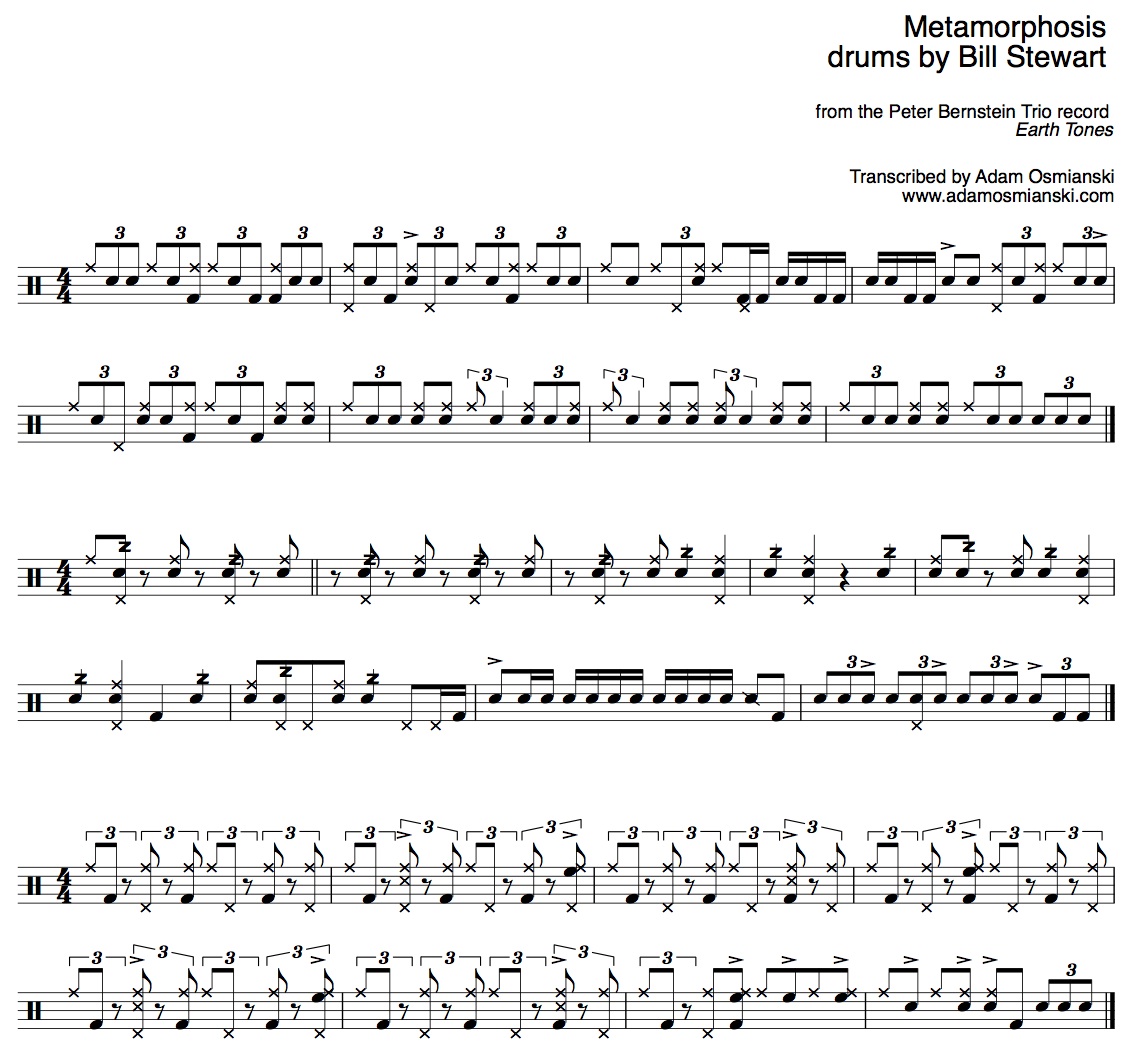
Again, grab the Jazz Samba Builder, and try mixing and matching some of the different combinations while playing along to this practice loop.
And if you don't already have it, pick up this album, why don't ya'.


Nana Vasconcelos (1944-2016)
Naná Vasconcelos, the unique Brazilian percussionist, singer and berimbau master has died in his hometown of Recife, aged 71. His vivid playing conjured echoes of the rainforest, scurryings in the undergrowth, the sudden flap of bird-wings, animal calls, the crackle of flames, cloudbursts and more. He busked on street corners, played with symphony orchestras, breakdancers, and with all manner of improvisers. In Brazil he first gained a reputation as a member of Milton Nascimento’s group, and he arrived in Europe in early 1970s as a member of Gato Barbieri’s band, basing himself initially in Paris. His highly productive association with Egberto Gismonti was begun on the often thrilling ECM recording Dança das Cabeças in 1976 and continued on albums including Sol do meio Dia, Duas Vozes and Nana’s 1979 leader date Saudades, for which Gismonti wrote the orchestral arrangements. (Egberto and Nana were due to revive their musical association this year, and a tour of the Far East had been booked for April)
Vasconcelos was one third of the magical Codona group with Don Cherry and Collin Walcott whose ECM recordings are reprised in the box set The Codona Trilogy. “Codona was the best collaboration in my life because it was a really unpredictable situation,” Vasconcelos told writer N. Scott Robinson in 2000. “Codona was true improvisation; freedom. Because it was true collaboration, three different persons, three different backgrounds put together.”
Nana Vasconcelos also appears on ECM albums with Pat Metheny, Jan Garbarek, Pierre Favre and Arild Andersen.
 |
| E-mail me for a PDF |


“I think the problem is that [people]...tend to approximate the product rather than attacking it in a realistic, true way at any elementary level - regardless of how elementary - but it must be entirely true and entirely real and entirely accurate. They would rather approximate the entire problem than to take a small part of it and be real and true about it. And I think this is a very important thing that you must be satisfied to be very clear and very real and to be very analytical at any level. You can’t take the whole thing, and to approximate the whole thing in a vague way gives one a feeling that they...more or less touched the thing. But in this way you just lead yourself toward confusion. You know, and ultimately you’re going to get so confused that you’ll never find your way out.”
“It is true of any subject that the person that succeeds in anything has the realistic viewpoint at the beginning in knowing that the problem is large and that he has to take it a step at a time and he has to enjoy the step by step learning procedure.”
“The point is, what are you satisfied with? In other words, it’s better to do something simple which is real...it can still be satisfactory, but it’s something that you can build on because you know what you’re doing. ... Whereas if you try to approximate something which is very advanced and don’t know what you’re doing then you can’t advance and build on it.”
“The whole process of learning the facility of being able to play jazz is to take these problems from the outer level in, one by one, and to stay with it at a very intense conscious concentration level until that process becomes secondary and subconscious. Now, when that becomes subconscious then you can begin concentrating on that next problem which is to allow you to do a little bit more.
“I would certainly say it’s more than worth it, but I think most people just don’t realize the immensity of the problem and either because they can’t conquer [it] immediately think that they haven’t gotten the ability or they’re so impatient to conquer it that they never do see it through. But, if you do understand the problem I think then you can enjoy your whole trip through.