King is one of my favorite modern drummers, so I was naturally quite excited when I saw he had a series of instructional videos. However, hilarity quickly ensued and I realized that this was not your typical drum video. It’s more of a parody of the myriad of drum videos out there today. But amidst all the levity there's some great drumming, and through some clever sarcasm, King drops in quite a bit of valuable wisdom. The whole series is definitely worth checking out.

Thursday, May 28, 2015
Dig This - Rational Funk with Dave King
Clearly I’m not paying enough attention, because it was only a couple weeks ago that I first discovered Rational Funk with Dave King.

Wednesday, May 27, 2015
7-stroke roll notation in Wilcoxon
Recently, on the Drummerworld Forum, someone asked a question about the notation of 7-stroke rolls in the Wilcoxon books. I field this question quite often from my students as well.
Many of the youngsters today are not familiar with the notation style of Wilcoxon. Most of the rolls, like the 5-stroke and 9-stroke are pretty much self-explanatory. However, when the 7-stroke comes in it’s a bit different. The thing to remember is that there is not one set way or rhythm in which to play a 7-stroke roll. The name simply describes how many strokes are in that roll.

Take Solo No. 26, for example, from The All-American Drummer. In the first two measures we see a 7-stroke roll on the “&” of beat 2. In this instance, the skeleton of the roll would actually be played as a 16th note triplet. In line 3 we again see a 7-stroke roll notated on the “&s” of 1 and 2, but here they have a ruff in front of them. When you see this, the ruff, which falls on the 16th note before the 8th note, is treated as part of the 7-stroke roll. Is it 2 of the 7 strokes. This changes the rhythmic makeup of the roll. It now becomes what is called a “tap seven”, which is a single stroke on the downbeat, followed by double strokes on “e, &, a”. Here is each type of 7-stroke roll with its modern notation equivalent.

Stylistically, the triplet-based 7-stroke that starts on the “&” is played behind the beat, almost out of time. There is a small breath before it is played, and the rhythm itself it stretched. There are quite a few examples of this interpretation here:


Stylistically, the triplet-based 7-stroke that starts on the “&” is played behind the beat, almost out of time. There is a small breath before it is played, and the rhythm itself it stretched. There are quite a few examples of this interpretation here:
Saturday, May 23, 2015
Groove Transcription - Kenny Washington, "America"
If you're anything like me, you have a "go-to" groove. A tune is called with a certain feel, and if you're not feeling particularly creative that night you have a bag of grooves you can reach into to pull something out. But occasionally these can put us in a rut where we feel stuck always playing the same exact thing. When this happens to me I find that even the smallest changes can spark new inspiration. So generally I'll head straight to the record shelf and find something to transcribe.
Recently I was looking for a little something different to do with an Afro-Cuban 12/8 or Bembe feel. What I ended up pulling out was Bill Charlap's album Somewhere with Kenny Washington on drums. Kenny's groove on "America" is only a couple of notes different than my own "go-to", but those few notes made quite a bit of difference, and I got some great ideas for fills and minor variations.
Rather than transcribe the whole tune to leave you to sift through it, I've written this out like a worksheet. At the top is the basic groove (Kenny's "go-to", if you will) and below are some variations and fills that he plays throughout the tune. There are also a couple of practice loops there for you as well. One with bass and one without.
I know I always say this, but if you haven't checked out this album, or the Bill Charlap trio period you need to get on it. These three are the epitome of the classic jazz piano trio. They don't make 'em like this anymore.
Recently I was looking for a little something different to do with an Afro-Cuban 12/8 or Bembe feel. What I ended up pulling out was Bill Charlap's album Somewhere with Kenny Washington on drums. Kenny's groove on "America" is only a couple of notes different than my own "go-to", but those few notes made quite a bit of difference, and I got some great ideas for fills and minor variations.
Rather than transcribe the whole tune to leave you to sift through it, I've written this out like a worksheet. At the top is the basic groove (Kenny's "go-to", if you will) and below are some variations and fills that he plays throughout the tune. There are also a couple of practice loops there for you as well. One with bass and one without.
 |
| E-mail me for a PDF |
I know I always say this, but if you haven't checked out this album, or the Bill Charlap trio period you need to get on it. These three are the epitome of the classic jazz piano trio. They don't make 'em like this anymore.
Friday, April 17, 2015
Staircase of Independence
This is an exercise I typically give to my students who are fairly early on in their jazz drumming journey. But lately I've also been giving it to more experienced students as a bit of a brush up. What I've found is that every single one of them finds at least a few of the bars difficult. The reason for this, I'm guessing, is that fact that most of us work out of books like Syncopation and The Art of Bop Drumming, which presents pre-composed musical ideas based on common jazz vocabulary. However, many students don't take the time to learn to place notes in every crack and crevice.
I once got into a bit of a debate with a reader of this blog, who, after seeing another exercise I had posted told me that "Life is too short to waste time on such 'exercises'". That made me stop and think for a minute. Could he be right? After all, we're trying to make music. Everyone seems to be obsessed with technical aptitude nowadays; sometimes to the point of detriment to the music. Why bother with hours of patterns and exercises? We should be expressing ourselves! But my doubt was very short lived once I remembered my own advice that I give to all of my students, which is to remember that music truly is a language and all of these exercises that we work on are part of our vocabulary. The larger our vocabulary, the more effectively we can articulate what it is that we would like to convey. It’s no different than speech, really. As toddlers we could point and bang things and shout to get what we wanted, but as we get older and develop a fuller vocabulary we can be more specific and convey our feelings with eloquence and style. By working exercises like this we further our ability to take the ideas that we think and feel and release them through our limbs.
OK, on to the notes. You can apply this to any number of styles, but as I said, I generally use this with students who are learning to play jazz. Swing time in the right hand, read the exercise with the left hand, right foot and left foot.
I’ve notated it so that makes sense to read it both across and down. By reading across you shift horizontally, one note at a time. By reading down you start in the same place every time but add two notes, then three.

I’ve notated it so that makes sense to read it both across and down. By reading across you shift horizontally, one note at a time. By reading down you start in the same place every time but add two notes, then three.
Monday, April 06, 2015
Dig This - Sammy Davis Jr. on the skins
Well here's a great video for a Monday morning.
Apparently, not only was Sammy Davis Jr. a phenomenal singer, and one of the coolest cats ever to wear a suit, but he could actually kick a band as well.
Friday, March 27, 2015
3, 5, 7 Exercise
Here is a versatile coordination concept that I often use when working on new groove ideas. For lack of a better name I simply call it 3, 5, 7, because what we are essentially doing is implying 3, 5 and 7 (8 or 16) over 4/4. By implying odd time signatures we can play over the bar line and build longer phrases with a more fluid sense of improvisatory time playing while also strengthening our coordination over a new ostinato or grooves. In general I try not to think of this exercise in terms of one time signature being implied over another. I’m not trying to see how many mathematical permutations I can achieve. I’m simply trying to further develop coordination and facility in improvising. Remember, music, not math.

There are a number of different ways you can use this concept. As I’ve been doing a lot of samba stuff lately let's start with that as an example. Say you’re working on some of the patterns from the Jazz Samba Builder. You’re comfortable with many, or all of the combinations, and now you want to start playing longer phrases and improvising.
Try, say, the second ride cymbal pattern, with the first bass drum pattern, and upbeats on the hi-hats, which would look like so:

With the left hand, then, try each of the 3, 5, and 7 exercises (the note values will be cut in half). You can orchestrate them as a rim click, or lightly on the snare. As with the Four Limb Warm-Up exercise, these will naturally resolve after an odd number of bars, but you should work in more common phrases, like 4, 8 and 12 bars. The best way to do this, of course, would be to play along with music rather than using a metronome. Each of them would look like this:


Once you’re comfortable with each of them, you can thicken things up a little bit by adding a “skip” note. Any time you have note followed by two 8th note rests, play two notes instead of just one, which will look like so:

Applied to the previous exercise:


We can also achieve some great textures by applying this to the ride cymbal. Use the same feet patterns as before and play the 3, 5, and 7 patterns on the ride cymbal. With your left hand you can fill in the gaps:


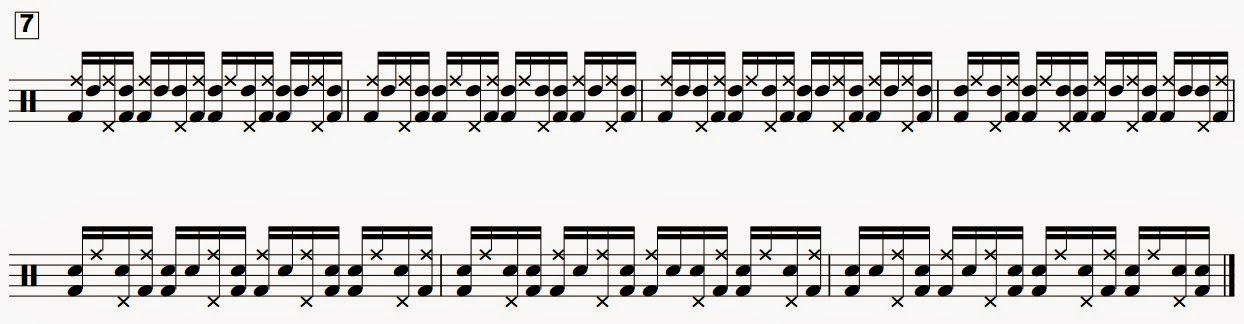
Or for a sound with a little more depth I like to play the snare drum on all of the 16th note upbeats (this fits the samba feel particularly well), like so:


If you’re feeling a little more ambitious, you can try to play some of the left hand patterns from the Jazz Samba Builder sheet while you play the 3, 5, 7 ideas on the ride.
You can also apply this concept to your feet, and any number of different types of grooves. Use it to develop coordination, longer phrases, soloing ideas, etc. Once you’re comfortable with whatever way you try to orchestrate these ideas, start improvising with them by stringing them together and mixing and matching.
Although I have notated some examples for you here, I recommend that whatever you apply this concept to you do so without reading. Learn to feel these ideas rather than trying to think of one time signature over another.
You can also apply this concept to your feet, and any number of different types of grooves. Use it to develop coordination, longer phrases, soloing ideas, etc. Once you’re comfortable with whatever way you try to orchestrate these ideas, start improvising with them by stringing them together and mixing and matching.
Although I have notated some examples for you here, I recommend that whatever you apply this concept to you do so without reading. Learn to feel these ideas rather than trying to think of one time signature over another.
Friday, March 13, 2015
Philly Joe Jones - "How About You?"
Well, after a busy first part of the year it's high time for the first Philly Joe Phriday of 2015!
After the great response I received from the last PJP, where we looked at comping, I decided to do another; this time from a lesser known, but killer record by a bari sax player named Serge Chaloff. Chaloff played bari in most of the great big bands (Ellington, Basie, Jimmy Dorsey, Woody Herman) and is considered the first bebop bari sax player. Unfortunately, like so many jazz greats of the time, Serge died young. He, like Jones, battled heroin addiction, but was able to get himself clean before dying of spinal cancer.
In this recording of How About You? we again hear Philly Joe teamed up with Sonny Clark and bassist LeRoy Vinnegar. Check out the last PJP post for some notes about Philly Joe's ride pattern, shaping, etc.


After the great response I received from the last PJP, where we looked at comping, I decided to do another; this time from a lesser known, but killer record by a bari sax player named Serge Chaloff. Chaloff played bari in most of the great big bands (Ellington, Basie, Jimmy Dorsey, Woody Herman) and is considered the first bebop bari sax player. Unfortunately, like so many jazz greats of the time, Serge died young. He, like Jones, battled heroin addiction, but was able to get himself clean before dying of spinal cancer.
In this recording of How About You? we again hear Philly Joe teamed up with Sonny Clark and bassist LeRoy Vinnegar. Check out the last PJP post for some notes about Philly Joe's ride pattern, shaping, etc.
Tuesday, March 03, 2015
Solo Transcription - Antonio Sanchez, "Jackalope"
So, I finally got around to watching Birdman the other night, and besides being a very cool movie, the score is everything it's cracked up to be. This led to me pulling out a bunch of Antonio Sanchez stuff to listen to during all the driving I've been doing lately.
One of my favorite projects that Sanchez has been a part of is the New Gary Burton Quartet. I saw this group a few year ago at Ronnie Scott's and was blown away. Gary Burton is, of course, Gary Burton. Not much else needs to be said there. Rounding out the group is Julian Lage - who is still only 27 years old yet plays with the maturity of someone far beyond his years - and bassist Scott Colley.
So, in honor of Sanchez being snubbed by the Oscars, here is a transcription of his solo on the tune Jackalope from the NGBQ album Guided Tour, which, if you don't have it yet, is totally worth checking out.


One of my favorite projects that Sanchez has been a part of is the New Gary Burton Quartet. I saw this group a few year ago at Ronnie Scott's and was blown away. Gary Burton is, of course, Gary Burton. Not much else needs to be said there. Rounding out the group is Julian Lage - who is still only 27 years old yet plays with the maturity of someone far beyond his years - and bassist Scott Colley.
So, in honor of Sanchez being snubbed by the Oscars, here is a transcription of his solo on the tune Jackalope from the NGBQ album Guided Tour, which, if you don't have it yet, is totally worth checking out.
Subscribe to:
Posts (Atom)