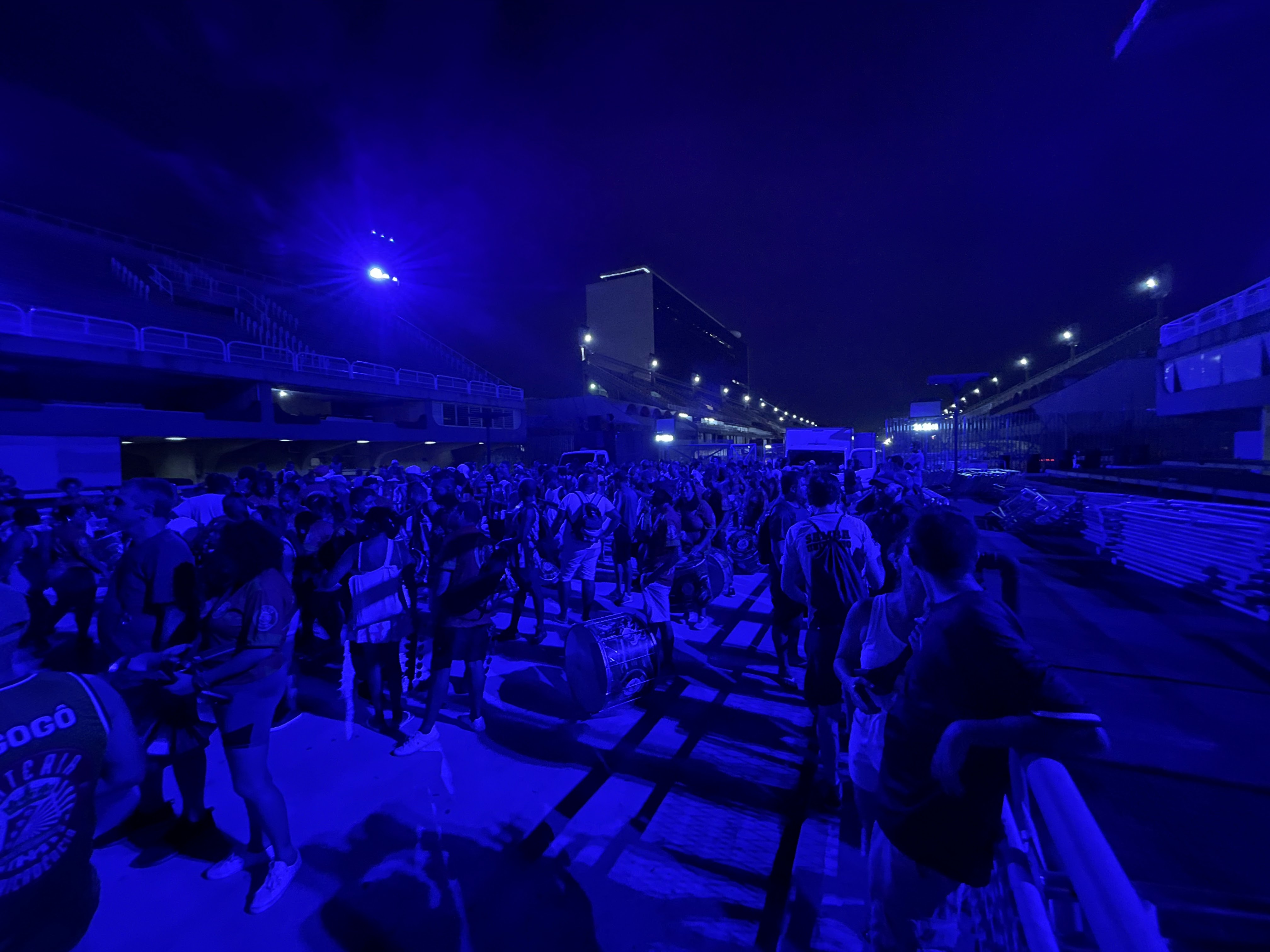
I was fortunate enough to kick off 2024 with another trip to Brazil along with many of my fellow Brazilian music nerds here in London.
With only a few short weeks to Carnival, Rio was completely abuzz with incredible music and atmosphere. Whereas on the last trip in 2022 I saw more jazz, this trip afforded me the opportunity to visit some of the samba schools as they prepare for Carnival.
I did have a chance to catch up with some of my favorite drummers, and new friends that I met on the last trip, like Renato Massa, Marcus Thadeu, and Marcio Bahia.
Marcio Bahia
But thanks to some well connected friends I was able to visit some of the oldest, and most respected samba schools in Rio, like....
Portela
Mangueira
Salgueiro
....and see some technical rehearsals in the Sambódromo.
I also had the great pleasure of seeing master pandeirista, Bira Presidente, at Cacique de Ramos, where Fundo de Quintal was formed.
If, by chance, you're at all interested in seeing more pictures and videos from the trip, you can head over to my Instagram page and see "Brazil trip '24" in my highlighted stories.
Now that I'm back in cold, dark London, I have quite a few posts in the works that I hope to get up here for you soon.
It's hard to believe, but I first posted to this, my own little nerdy corner of the internet, 10 years ago today. Thank you very much to everyone who has read the blog, and been in touch with questions and comments. I have enjoyed it immensely. Some years I post more than others, but regardless, I have no plans of stopping any time soon and hope that 2024 will afford me some more time to transcribe, write, post and share with all of you.
Let’s start the meat of this series with the rhythm of forró that many drummers are familiar with on one form or another, baião. For most drumset players, baião simply means this groove:
And I wouldn’t even say that that’s wrong per se. It’s just missing a lot of nuance that makes a baião what it is. And without that nuance one could also be playing a forró or a xaxado as all three of these styles have this cell in them:
But it’s the way that that cell is articulated, as well as the other percussion and melody parts surrounding it that differentiate the three styles.
In this post I'll be referring to the instruments of forró. If you're not sure what I'm talking about, be sure to check out part 1 of this series.
The zabumba is played with both dead strokes (which mute the head and give a short, staccato sound) and open strokes (which allow the head to ring out). The placement of the closed and open strokes is part of what differentiates baião, forró and xaxado. In a baião, the first stroke is muted, while the second is open.
Baião also tends to be driven more by an 8th note subdivision, rather than a 16th note subdivision. That’s not to say one wouldn’t play 16th notes at all. But in baião the bacalhau plays mostly 8th notes with less 16th note syncopation. The most common bacalhau parts are:
Put together, some standard baião interpretations would look like this:
This 8th note subdivision mirrors the melodies which, in baião, are also 8th note heavy and are more relaxed and lyrical. Baiãos also tend to be played and medium tempos. Check out Luiz Gonzaga singing “Baião”. It’s quite legato, and sung almost entirely in 8th notes on the beat at a very reasonable and groovy tempo.
The open sound of the zabumba on the “a” of 1, and the relative lack of variations filling out beat 2 provide the more fluid melodies of baião the space they need to breathe.
I believe it's because of that space that variations and fills in baião are used more sparingly than in other forró styles, but here are some ideas you might come across:
Most of these variations show the bacalhau on the upbeat, but you could easily play the other bacalhau parts above.
To apply this to the drumset we don’t even need to re-write the part. Simply play the bacalhau part on your snare drum (a cross stick is probably most appropriate), and the low zabumba part on your bass drum. Given that the closed and open strokes really characterize the different rhythms you may even want to try to imitate this yourself on the bass drum by burying the beater and playing off the head, but it certainly isn’t easy to coordinate at first.
If you’re able, I would play all four subdivisions on the hi-hat as this most closely mimics the triangle part which is integral to forró grooves:
Most drummers tend to play
with the right hand, presumably out of habit from playing jazz and other styles that rely heavily on that rhythm. But if the tempo or your current ability won’t allow you to play all four 16th notes, I feel that
captures the essence of the triangle more, especially if you play a small lift on the &, or the e&.
You could also try something I’ve been experimenting with lately, which is playing 1e& on the hi-hat with your right hand, lifting on the &, and snapping the hi-hat shut with your left foot on the “a”, giving you all four subdivisions of the triangle.
Below are all the variations we looked at today, orchestrated for triangle and zabumba. Drop me and e-mail for a PDF.
In the next part of the series we'll look at the forró rhythm and how it differs to baião.
I’ve touched on forró and baião on the blog before, but after some questions from friends and students, I figured it was time for a more detailed dive into the defining characteristics of the various rhythms of forró, how to differentiate between them, and how we can apply them to the drumset.
First off, the terms themselves can be a little confusing. “Forró” is a genre of music originating in the state of northeastern Brazil called Pernambuco. It is a family of multiple rhythms and dances. Where the confusion often comes in is that one of the rhythms in said family is called “forró”. Here’s a little chart to clarify.
THE RHYTHMS OF FORRÓ
-Baião
-Forró
-Xaxado
-Xote
-Arrasta-pé
We’ll talk about each of these rhythms in the coming parts of this series, but let’s first look at a little bit of background. The roots of the music go back further, but the rise of forró in popular Brazilian culture is typically attributed to the accordion player Luiz Gonzaga.
He is also credited with creating baião as we know it in the 1940s and 50s. Other well known forró musicians are Dominguinhos, Jackson do Pandeiro, Trio Norestino, Humberto Teixeira, and nowadays, Mestrinho.
While forró can be played on a number of different instruments, and ensembles can range in size and variety, the most traditional forró ensemble is a trio, consisting of an accordion, a triangle, and a zabumba. A zabumba is essentially a bass drum worn on a sling. This is where most of our drumset adaptations come from. The top head is played with a mallet, and is usually muffled in the center, and the bottom head is played with a very thin stick called a bacalhau, creating a very high-pitched snap.
Next time we’ll start looking at the actual rhythms and what we can do with them, but in the meantime, you can check out this live concert of Luiz Gonzaga with his trio. This will give you an idea of what a traditional forró group looks and sounds like. If you listen to the whole thing you’ll each each of the rhythms of forró at some point, and you can get an idea of how the zambumba is played. If you don’t plan to watch the whole thing, you can jump to 19:26 where Gonzaga plays arguably his most famous tune, named after the genre he created, “Baião”.
The other day John Riley did a guest spot on the Memphis Drum Shop instagram page where he broke down a flam exercise he developed that employs 5 flam rudiments in descending order of length. He created the exercise in response to Joe Morello telling him that a "professional drummer" should be able to play flamadiddlediddles as sextuplets at 120 bpm. John describes this as "wicked fast", and I couldn't help but noticed that he didn't actually play them at that tempo in the video. I know I can't! Either way it's a fun and handy little exercise so I jotted it down to share with you.
If you're a regular reader of the blog then I certainly apologize for my incredibly light posting in recent months. For one, I'm working on a new record with my band, Samba Azul. But also, I've been building my own pandeiros, which I'm delighted to share with you now.
I'm not bending my own shells, yet. But everything is cut, drilled, filed, and finished by hand. And most importantly, the platinelas (jingles) are completely hand cut, hammered, and lathed.
I've been working with blank shells, but I've also experimented with upcycling old toms that have been separated from their drumset family.
If you're interested in purchasing one, drop me an e-mail and we'll chat about the different options available.
Kiko Freitas recently posted this exercise in which he plays a double stroke roll in groupings of 5, 7, and 9. In the post Kiko points out that this is a good way to develop technique and internal time. I also find it helps me hear - and more importantly, feel - odd note groupings and visualize them in different ways as with each odd grouping you'll start once on the first note of a double on each hand, and once with the second note of a double on each hand.
I would start by spending some time with each tuplet, but once you start to get comfortable with it you can try a bar of quintuplets, a bar of septuplets, and a bar of ninelets (nonlets?), and then work your way back down.
Apparently, this is how the great Brazilian drummer, Toninho Pinheiro, liked his sticks....
And I think his were even sharper.
Now, I didn't want to destroy a perfectly good pair of sticks, so I figured I'd try it on an old pair first. These were chewed up from many a rim click, and the tips were chipped. So I sanded the shaft smooth, sanded the tip all the way off, and then applied a couple coats of finishing oil, and I have to say, they're actually pretty cool. Not sure I'll be doing it all the time, but it was a worthy experiment.
Toninho first started doing this because he was playing background music in restaurants and wanted a more delicate sound without having to mute his heavy Zildjian Avedis cymbals. It ended up becoming part of his sound as he found the modified sticks to be perfect for the delicate cymbal sound needed to play Bossa Nova.
I didn't do the final step, which was, after removing the tip with sandpaper, dipping the new tip in a mixture on paint thinner so as to draw out any moisture, which further helped to create a light attack. He used to heat his sticks for the same reasons.
I've read that other Brazilian drummers of the time did this as well so as to be able to play faster tempos at lighter dynamics, but I can't seem to find reference to any names other than Toninho.
Tonhino's name doesn't seem to get mentioned as much as Edison Machado, Milton Banana, and Dom um Romão, but you should definitely check him out if you're at all interested in Brazilian jazz. He did long stints in Jongo Trio who supported Elis Regina, Som Três, a trio with Cesar Camargo Mariano that backed Wilson Simonal, and with Dick Farney's trio. And he worked as a sideman with many of the biggest names in Brazil, like Alaíde Costa and Beth Carvalho.